
Sudan Media Forum
By Eisa Dafallah
KHARTOUM, August 20, 2025 (Jibraka News) – When war erupted in Khartoum, journalist Ali al-Arsh was forced to flee to his hometown of Sinjah . There, in the relative safety of the Sinnar State capital, he continued to report. But his work did not go unnoticed.
“Because of my reporting—which exposed violations and shed light on official negligence and oppression—I was arrested on August 21, 2023, by the intelligence service,” he recounts. “I spent more than six days in detention where I endured constant threats and torture, and was barred from seeing my family or practicing my profession.”
The reporting that led to his persecution, al-Arsh explains, focused on the dire humanitarian crisis unfolding in plain sight. “I witnessed firsthand a human tragedy I never imagined could occur inside the displacement centres, which were supposed to be a refuge for thousands fleeing the horrors of war.”
His interviews revealed a reality beyond description: people living in squalor, deprived of basic necessities, and subjected to constant harassment and racial profiling that he says is characteristic of the conflict.
“In the midst of this devastation, local volunteers were a beacon of hope,” al-Arsh adds. “They established emergency response rooms that became lifeboats, providing food, medical care, and shelter. These grassroots initiatives were a true lifeline.” Yet, these humanitarian efforts were met with official obstruction, culminating in the arrest of volunteers and the forced closure of their vital operations.
The persecution soon escalated. “The violations did not stop with my arrest,” he says. “The authorities raided my family’s home at two in the morning, arresting my younger brother and his cousin as ‘hostages’ to pressure me to turn myself in.”
A Pattern of Persecution
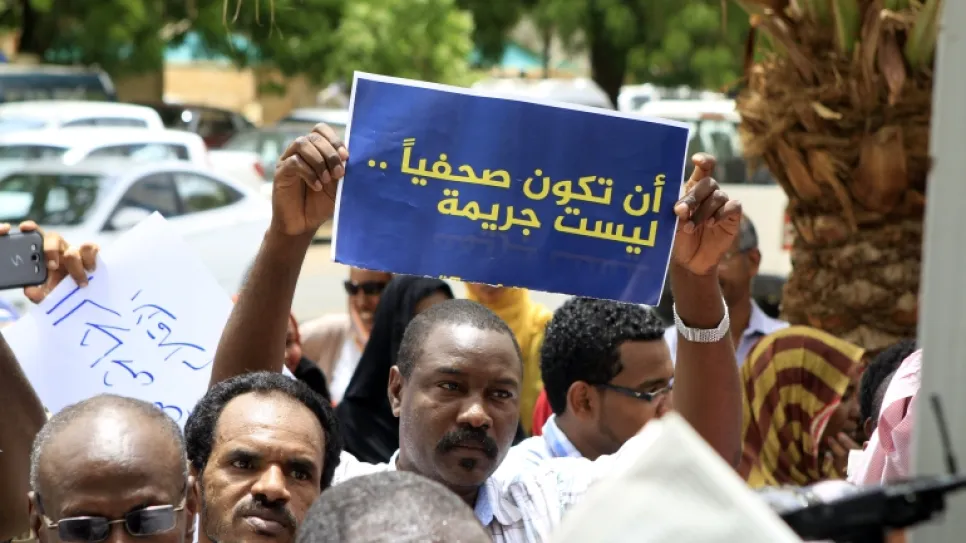
Al-Arsh’s ordeal is not an isolated incident, he says, but is emblematic of a pattern of persecution threatening journalists across Sudan. Arbitrary arrest and detention are routinely used to silence reporting. Beyond that, journalists face kidnapping, extortion, and assassination, especially when covering war crimes and human rights abuses. These dangers are compounded by constant digital surveillance, online smear campaigns, and intimidation.
The statistics paint a grim picture. The Sudanese Journalists Syndicate has recorded 556 violations against media workers in two years of war, including the targeted killing of 31 journalists. A report last May confirmed that at least 239 journalists had been arrested and detained, with dozens more facing beatings and abuse.
Reporters Without Borders (RSF) confirms that those who harass and assault journalists are often protected by the authorities and enjoy total impunity. Since the war began, media headquarters have been looted and destroyed, and attacks have surged, compelling many journalists to flee the country.
From the besieged city of El Fasher in North Darfur, journalist Mohamed Ahmed Nizar’s story is a stark example. “I was arrested after I published a story about an officer from an armed group shooting my colleague,” he says. “Leaving is the only solution, no matter the challenges. I have a shrapnel injury in my leg, and life is unbearable amid constant threats and brutal living conditions. Many young people can’t even find one meal a day.”
Systematic Targeting or a Symptom of Chaos?
Journalist Abdel Azim Qulo, also from North Darfur, offers a nuanced view. “The targeting of journalists is complex. It’s not always systematic, nor is it purely incidental,” he argues. “It is often a mixture of both.” He explains that while many attacks are deliberately planned to control the media narrative and silence those who expose corruption or war crimes, others are opportunistic acts in a lawless environment. Qulo notes that journalists are often labeled as military targets or accused of espionage, in direct violation of international humanitarian law.
However, Ezzedine Arbab, head of the Sudanese Journalists’ Association in Uganda, argues unequivocally that the targeting is systematic across all regions of Sudan. “Journalists live under constant pressure, with threats directed at them and their families,” he says. He describes a climate where independent reporting is impossible, noting that simply carrying a camera can get you arrested.
“Both warring parties consider a journalist who is not unconditionally supportive of them to be an enemy working for the other side,” Arbab states. “This is extremely dangerous and has driven many journalists to abandon the profession for manual labour or trade just to survive.”
Iman Fadl al-Sayed, the Freedoms Secretary of the Journalists Syndicate, concurs that the media is being systematically dismantled. She provides chilling details to support this claim, confirming that four journalists have been killed while in state custody. Many others, she explains, were arrested at checkpoints simply because their press cards identified their profession. This persecution has even extended to the sources who speak to journalists, who are often hunted down and interrogated.
“A huge number of journalists have been forced to quit,” she concludes. “Even those who work from exile are not safe from threats. Many have imposed a strict self-censorship on their own social media accounts out of fear. There is a growing retreat from expressing any opinion at all.”
An Appeal for Protection
Journalist Zamzam Khater says the goal is to create a vacuum of information. “The warring parties do not want independent witnesses,” she explains. “Journalists are trapped in an impossible position: either align with a faction to survive or maintain independence and risk everything—arrest, kidnapping, torture, or death.”
The ultimate price, she says, is being forced to flee one’s home just to stay alive. “There is no entity that has the power to protect any civilian, let alone a journalist, because this conflict lacks any ethical boundaries.”
Yet, Khater points to a glimmer of hope in civil society. She cites the recent release of two journalists in El Fasher as proof that coordinated pressure from Sudanese journalists and civic groups can work.
Others agree that a collective effort is the only way forward. Al-Arsh calls for comprehensive safety training, while Arbab insists on sustained international pressure and “unwavering professional solidarity” to counter the attempts to silence a free press.
—-
This report was prepared by Jibraka News. The Sudan Media Forum and its member organizations are publishing this material as a testament to the scale of the targeting and violations faced by Sudanese journalists. It documents the patterns of repression—from assassination and arrest to familial and digital persecution—aimed at silencing independent voices. It highlights a crisis of protection and impunity that is hollowing out the profession, and serves as a call for solidarity and pressure to safeguard press freedom in Sudan.


