
Sudan Media Forum
Cairo, 28 June 2026 – Since the outbreak of the war in Sudan in April 2023, nearly 1.5 million Sudanese have fled to Egypt, according to the United Nations High Commissioner for Refugees (UNHCR). Women and children make up the majority of those who arrived. For thousands of Sudanese refugee women, however, displacement quickly turned into an economic struggle, forcing them to seek any available source of income after losing their jobs, savings, and livelihoods.
In factories, farms, and private homes across Egypt, Sudanese refugee women work long hours for low wages, often without employment contracts or legal and social protections. Many were once teachers, administrators, and university graduates with professional careers, yet the war has driven them into physically demanding manual labour far removed from their qualifications and experience.
This investigation is based on field interviews with Sudanese refugee women employed in manufacturing, agriculture, and domestic work across several Egyptian governorates. It also draws on interviews with legal experts and specialists in refugee and gender issues, alongside a review of Egyptian labour legislation and reports by international organizations.
Despite the diversity of their backgrounds, the women’s testimonies reveal a strikingly consistent pattern of vulnerability. Nearly all arrived in Egypt during 2023 and 2024 and hold refugee cards issued by UNHCR. Most secured employment through labour brokers or personal networks, in the absence of formal recruitment channels. Daily wages generally range between EGP 150 and EGP 300 for shifts lasting between eight and twelve hours—sometimes extending to sixteen hours. Many reported repeated delays in wage payments, arbitrary deductions, and an almost complete absence of formal contracts or legal safeguards.
From Professional Careers to Manual Labour
The transition from professional employment to manual labour was not an isolated experience but the defining reality shared by nearly all the women interviewed.
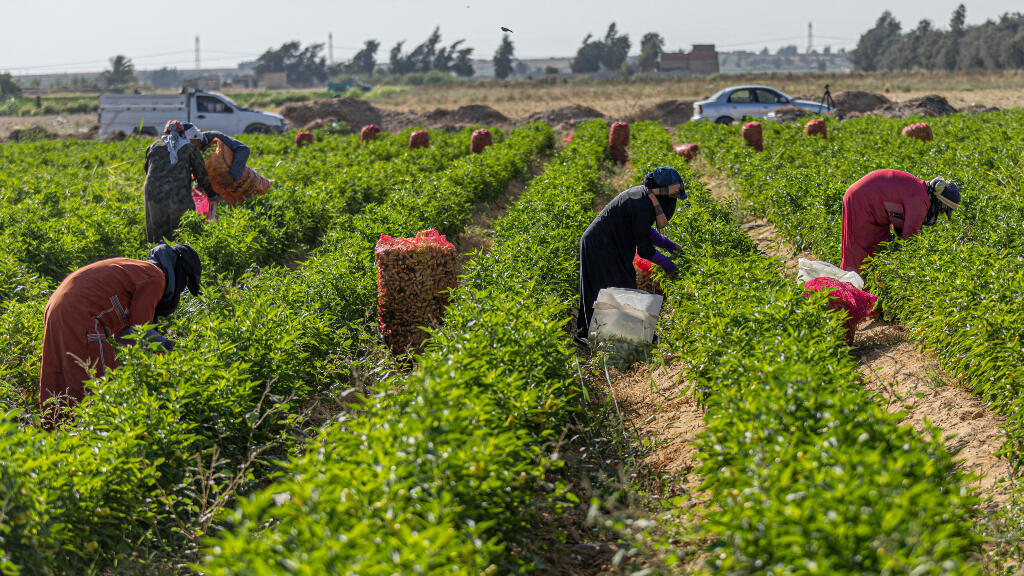
Among them are former teachers, school principals, government administrators, university graduates in medical laboratory sciences, computer science and accounting, and the owner of a private kindergarten. Years spent building professional careers came to an abrupt end with the outbreak of war, leaving them working in plastic, chocolate and frozen food factories, or harvesting berries, grapes and strawberries on Egyptian farms.
H.A.M., a computer science graduate who previously worked in the accounts department of a government institution in Sudan, said that after arriving in Egypt she found no option other than factory and farm work to support her family. She moved between packaging, chocolate and plastic factories, in addition to working on berry farms, where shifts sometimes stretched to twelve hours a day.
She explained that many vacancies are advertised online or circulated informally among women workers, while others are controlled by labour brokers who occasionally demand payment in exchange for securing employment—something she refused.
“Most job opportunities are found through online advertisements or informal networks among women workers. We help each other find jobs in factories because there are no stable recruitment channels.”
Working conditions, she said, vary significantly. Some factories provide basic facilities, while others lack even minimal rest areas or essential services. In many cases, the work assigned expands beyond the original agreement, with women hired for packaging later required to load and transport heavy products without additional pay.
N.M.M., a former teacher and mother of five, described a similar experience. After settling in one of Egypt’s industrial cities, she alternated between frozen food factories and grape farms. Although her daily wage gradually increased from EGP 150 to around EGP 240, irregular work left her income unstable.
She said some employers prefer hiring workers from other nationalities, while Sudanese women are sometimes excluded because of their age or simply because “they are no longer needed.”
She added that the absence of formal contracts leaves workers at the mercy of brokers. Both she and her daughter were defrauded on multiple occasions, losing thousands of Egyptian pounds with no legal avenue to recover the money.
“My daughter and I lost nearly EGP 3,000 in one incident and another EGP 2,500 in a separate scam.”
Yet, she said, what worries her most is not the long working hours but being forced to leave her children unattended while she goes to work.
For Z.M.A., a 55-year-old former deputy school principal, the transition from education to factory and agricultural work was among the hardest consequences of displacement.
She said she often works two consecutive shifts—up to sixteen hours a day—to cover living expenses and medical costs. Older women, she added, face even greater obstacles because employers generally prefer younger workers.
Many women, she noted, do not even know the identity of their actual employer because they are recruited through intermediaries and subcontractors. This makes filing complaints or claiming labour rights extremely difficult, especially when workers face wage deductions linked to productivity targets or quality assessments and fear losing their jobs.
N.A.A., a former school principal from Omdurman, described even harsher working conditions. After arriving in Egypt, she worked in fruit and vegetable packing factories, where the duties assigned to her extended far beyond the original agreement.
Instead of simple packaging work, she was required to carry heavy sacks, chop vegetables, and endure long working hours. She says these conditions resulted in a slipped disc, chronic back pain, and respiratory problems caused by working in onion-processing and frozen food sections with poor ventilation.
She also recalled one incident in which she agreed to work under a production-based payment system for EGP 400 a day.
“I packed 50 out of the required 55 boxes, but when I collected my wages I received only EGP 300 after EGP 100 was deducted because I supposedly failed to meet the production target.”
Her account is echoed by A.A., another agricultural worker, who said:
“Working conditions were unstable. Sometimes women were simply not paid at all or were dismissed at the end of the day without receiving any wages.”
In another factory, N.A.A. recalled that the owner entered the production area while intoxicated, shouting and banging on tables in front of the women workers. When she attempted to leave in protest, she was ordered to continue working.
She was later injured while working in another factory, but the first-aid supervisor refused to treat her. She bandaged her own injured finger to avoid losing her day’s wages.
She also described discriminatory treatment.
“Some supervisors and co-workers treat Sudanese women with discrimination or bullying. I have diabetes, yet some supervisors refuse to allow me to use the restroom when I need to.”
Reflecting on how dramatically her life had changed, she said:
“I once carried chalk and a pen. Today I endure humiliation doing work that bears no relation to everything I spent years studying and teaching. All I want is to return home.”
H.M.A., a computer science graduate and former owner of a kindergarten in Sudan, shared a similar story.
Mounting financial pressures forced her to work on farms, before eventually bringing along her two daughters, aged 17 and 14, so the family could afford rent and basic necessities—a stark illustration of how the war has jeopardized not only livelihoods but also children’s education.
“The first shift began at five in the morning in grape farms, before we moved to strawberry fields. The work required keeping our hands raised for long periods while tending grape vines or remaining bent over while harvesting strawberries. Our break lasted no more than ten minutes. At the beginning of 2024, each shift paid EGP 150, so we worked two shifts a day to earn EGP 300. We had to stop one of my daughters from working whenever school exams approached so she could study.”
M.K.A., 26, a medical laboratory graduate now working on a strawberry farm, described the work as physically exhausting.
She said women workers receive only one short meal break after hours of continuous labour and sometimes have their food and drinking water stolen, with no effective complaint mechanism or protection.
“I have repeatedly experienced racism and mistreatment.”
She also developed a skin allergy after handling chemical fertilizers without gloves or protective equipment.
She further highlighted unsafe transportation conditions, explaining that vehicles carrying women workers to the farms were routinely overcrowded far beyond their intended capacity, increasing the risk of road accidents and making already exhausting commutes even more difficult.
D.B.A., 39, a mother of four, represents yet another story of professional loss.
When she arrived in Egypt in 2023, she brought with her an impressive academic and professional background. She holds a degree in industrial engineering, studied medicine, and had previously received an award as Syria’s Best Young Inventor.
None of these achievements shielded her from the precarious realities of displacement.
She moved between several Egyptian cities searching for work before taking jobs in factories and on farms. Thanks to her technical expertise, she was promoted from factory worker to engineer. Instead of improving her situation, however, the promotion exposed her to increased workplace hostility.
She said colleagues deliberately sabotaged export shipments and attempted to shift responsibility onto her because they viewed her as an unwelcome competitor.
She also reported repeated verbal abuse and harassment before one engineer violently pushed her into a wall.
Although she was later transferred to the human resources department, the psychological and professional pressure continued.
Her monthly salary stood at around EGP 6,000, rising to EGP 15,000 after allowances and bonuses. However, monthly deductions amounted to nearly EGP 4,000.
She eventually left and returned to daily wage work in factories and farms, earning between EGP 140 and EGP 180 per day.
She later found employment caring for an elderly woman, drawing on her medical background, for EGP 200 a day. She was forced to leave after being sexually harassed by the woman’s son and subsequently returned once again to factory and farm work.
W.A.A., 39, who holds a degree in business administration and previously worked in public relations for an airline in Sudan, described what was comparatively one of the more favourable experiences.
She secured employment in a women’s garment factory, working nine-hour shifts for EGP 750 per week.
Speaking about occupational safety, she said:
“The factory failed to provide adequate safety equipment. One worker suffered an injury serious enough to require hospitalization.”
After the factory owner discovered her computer skills and administrative experience, she was promoted to the accounts department with a monthly salary of EGP 5,500.
The Sudanese Media Forum and its member organizations are publishing this investigation in two parts to document how Sudan’s war has forced dozens of refugee women—many of whom previously held professional and administrative positions or possessed university degrees—onto factory production lines, agricultural fields, and domestic work in Egypt. Their testimonies demonstrate that educational qualifications and professional experience have offered little protection in exile. Instead, the urgent need to earn an income has exposed many to exploitation, abuse, and unsafe working conditions, underscoring the profound vulnerability of Sudanese refugee women living without meaningful labour protections.


