
Sudan Media Forum
Cairo, March 2, 2026 (Sudan Tribune) – When “A.A., a 35-year-old” Sudanese widow, fled her country amid the war between the Sudanese army and the Rapid Support Forces, she asked for only one thing: that her three children survive. Egypt seemed the safest place to seek refuge.
Yet the safety she found in Cairo has proven incomplete. After three years in exile, she now finds herself unable to secure even the most basic right for her children: education. The mother, who works in physically demanding and irregular jobs, says her children have “almost forgotten how to read and write” after being forced away from school for years—an experience that reflects the struggles of thousands of Sudanese refugee families in Egypt.
A.A. arrived in Egypt in 2024, eight months after the war erupted in Sudan. During her first year, she worked to regularize her residency status and register with the UN refugee agency. But in the following years, the cost of living steadily increased. Rent rose, and prices for electricity, gas, food, and medical care surged. https://www.facebook.com/share/v/1AmYHYCqJ8/
“My limited income barely covers housing and food,” she said. Despite working as a domestic helper, a shop assistant, and later in a clothing factory, she could not afford school fees for her children. “I chose for them to stay alive—even if that meant no schools.”
Her story is not unique. Mohammed Yahya, 47, who works as a security guard in the Cairo suburb of El-Shorouk City, earning less than 5,000 Egyptian pounds per month, faces the same dilemma every school year: which of his children can he afford to enroll?
This year, Yahya chose to register only his eldest son to sit for the Sudanese secondary school certificate exam. His three other children remain out of school for the third consecutive year—an illustration of the predicament facing thousands of Sudanese refugee families.
These personal testimonies reflect a broader crisis that deepened after a decision issued in December 2023 halted the admission of Sudanese students into Egyptian public schools.
The decision, announced for administrative reasons, effectively closed the door to low-cost public education, leaving thousands of families with limited and expensive alternatives.
Teacher Othman, who works at an international school in Cairo, says the decision “deprived the most economically vulnerable refugees of any real opportunity to access public education,” pushing families toward costly options such as Sudanese private schools, community learning centers, or international schools.
According to him, annual fees in education centers supported by organizations partnering with the UN refugee agency average around 8,000 Egyptian pounds for primary school, 10,000 pounds for intermediate level, and 12,000 pounds for secondary education. Fees at other community centers range between 12,000 and 15,000 pounds, while Sudanese private schools often charge even higher rates.
Complex Procedures
Beyond the financial burden, families also face complex administrative procedures. Othman Saad, 51, the father of two daughters, recounts a lengthy process to enroll his younger daughter, which included online payments, academic equivalency procedures, travel between Abbassiya and Egypt’s New Administrative Capital, and document authentication at the Sudanese embassy and Egyptian education authorities.
He says the registration process alone cost more than 12,000 Egyptian pounds, excluding the emotional stress and time spent navigating bureaucracy. “The process is exhausting for a refugee,” he said. “Even minor issues can force you to repeat the entire procedure.”
Schools Ill-Equipped for Learning
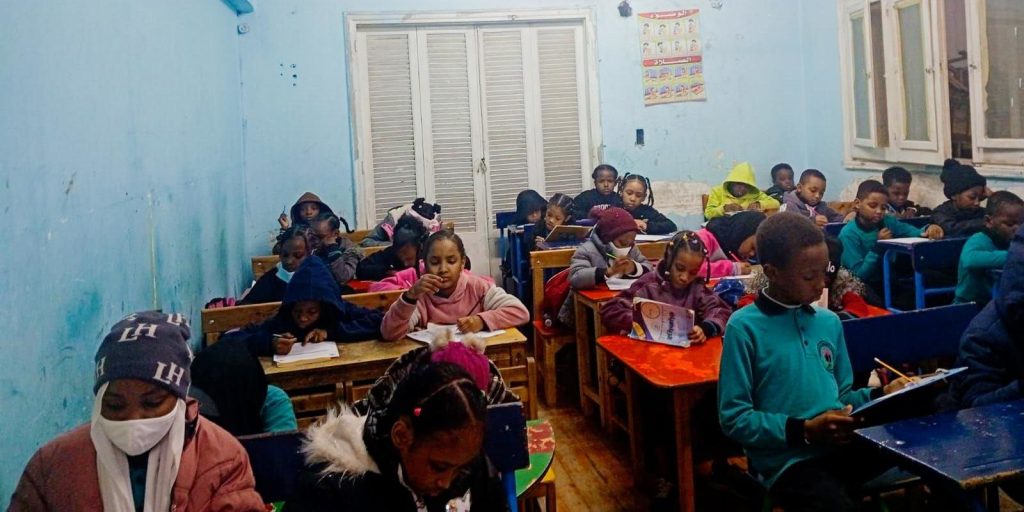
The crisis extends beyond affordability to the quality of education itself. Teachers and education activists say nearly 90 percent of schools and learning centers serving Sudanese students operate inside cramped residential apartments, most of which lack even the minimum educational standards.
In many cases, more than 30 students crowd into a single small room. Improvised spaces are used as classrooms, while teachers often sit in corridors or balconies due to the lack of offices. The school day can last up to eight hours with little extracurricular activity or psychosocial support for students.
In such conditions, worrying trends are emerging—including rising school dropout rates and child labor, according to teachers and community leaders in several Cairo neighborhoods.
Thousands of Children Out of School
A study conducted in October 2025 by a network of community education centers, obtained by Sudan Tribune, found that about 90 percent of refugee households are headed by women.
The study also estimates that more than 5,000 Sudanese children in Cairo are out of school, including over 1,000 children in the districts of Maadi and Helwan alone.
In Maadi alone, more than 25 community schools and kindergartens serve over 4,000 students across different grades, including 198 orphaned children aged between 9 and 14.
Limited Support from Aid Organizations
International organizations are attempting to fill part of the gap. Afaf Mirghani Ahmed, from the Excellence and Community Leadership Center in Omraneya, told Sudan Tribune that organizations such as Catholic Relief Services (CRS), Save the Children, and the NGO “STAR” provide teacher training, psychosocial support for students, and limited financial assistance to families.
However, she acknowledged that these efforts fall short of the scale of the crisis, particularly as rents and living costs continue to rise and the number of children needing education increases.
“Community centers have helped many students and families,” she said, “but they are forced to function as schools, which creates major operational challenges.”
Structural Failures in the Education System
Educational expert Ali Saeed argues that the crisis cannot be viewed solely as a wartime emergency. “What we are witnessing today is an extension of a historical failure in managing Sudan’s education system since independence,” he said, noting that displacement and refugee conditions have only exacerbated the problem.
He said Sudan’s education system has long relied on rote memorization rather than critical thinking and creativity, leaving it fragile and vulnerable to collapse under social or economic shocks.
In exile, Saeed warns, education has effectively become a commercial commodity, delivered at poor quality and high cost amid a shortage of qualified teachers, suitable school environments, and family stability.
The consequences, he says, extend beyond weak academic outcomes. “It creates a wide psychological and social vacuum among children and youth, leaving them vulnerable to crime networks or extremist recruitment.”
A Lost Generation?
Saeed warns that the most dangerous outcome is the “burning of educational years” for an entire generation of Sudanese children. “They are losing not only their right to education,” he said, “but also their trust in the school as a social institution.”
Even if they eventually return to Sudan, he warns, rebuilding their education will be extremely difficult. Societies that lose generations of educated youth, he added, often require decades to recover their economic and social balance.
Rising Costs and Growing Pressure
Journalist Asim Ismail told Sudan Tribune that Sudanese schools in Egypt charge “excessively high fees,” sometimes around 10,000 Egyptian pounds per student, an amount beyond the reach of most refugee families.
He criticized the lack of intervention from Sudanese authorities or the Sudanese embassy, saying families are also required to pay additional costs for exams, books, and administrative procedures. “This has broken the backs of many families,” he said.
As a result, some parents have kept their children out of school for the past three years. The situation has also contributed to rising child labor, with Sudanese children working in factories, farms, cafés, and on the streets as their parents struggle in low-paid informal jobs.
Official Position
Meanwhile, the cultural adviser at the Sudanese embassy in Cairo, Dr. Asim Ahmed Hassan, said that 145 Sudanese schools currently operate in Egypt, although some have not yet completed legal registration procedures.
Egyptian authorities have closed several schools in Aswan, Alexandria, and Badr City for failing to meet legal requirements.
Hassan said around 25,000 students will sit for the Sudanese secondary school certificate exams this year, scheduled to begin on April 13, adding that issues related to unlicensed schools will not affect the exam process.
A Complex and Deepening Crisis
Between families struggling with fees and bureaucracy, overcrowded and inadequate learning environments, expert warnings about long-term social consequences, and official responses focused mainly on administrative regulation, the education crisis facing Sudanese refugees in Egypt has emerged as a deeply complex one.
It is no longer simply a question of school fees or legal licensing. It is about the future of an entire generation—children caught between a war they did not choose and an exile where learning remains out of reach.
The Sudan Media Forum and its member institutions are publishing this report, prepared by Sudan Tribune, to highlight the deepening crisis affecting Sudanese refugees in Egypt, where many children have been deprived of their right to education after their schooling was disrupted by war. The report notes that the crisis intensified after a December 2023 decision halted the admission of Sudanese students into Egyptian public schools, effectively closing access to low-cost public education and leaving thousands of families with limited and costly alternatives. It also highlights that nearly 90 percent of schools and learning centers serving Sudanese students operate in cramped residential apartments, most lacking the minimum educational standards required for a proper learning environment.


