
Sudan Media Forum
By Maab Al-Mirghani
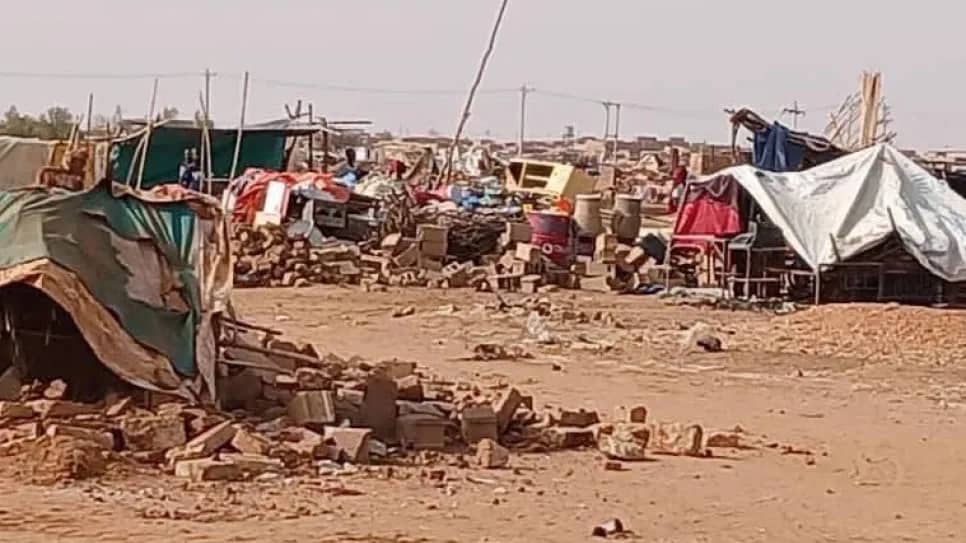
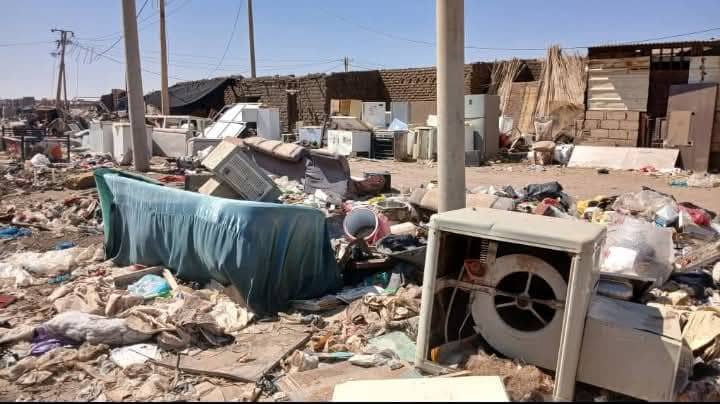
Khartoum, November 17, 2025, (Jubraka News) – Khartoum State has recently launched a sweeping campaign to demolish unplanned housing—often pejoratively labeled “random” or “chaotic”—in areas such as Mandela, Al-Suraiha, Al-Fitayhab, Al-Azba, and Al-Khairat. The campaign has sparked intense controversy between displaced residents, local authorities, and human rights advocates regarding the legality and justice of these measures.
Gubraka News spoke with several residents whose homes were leveled, uncovering stories that reveal the immediate humanitarian crisis caused by the loss of shelter and livelihoods, and the uncertainty clouding their future.
A Cycle of Suffering
Mohamed El-Tayeb (a pseudonym used for his safety) says his life was upended on the morning of October 19, 2025. On that day, his family lost their home in the Mandela neighborhood of the Mayo area, south of the Green Belt, where they had lived since 1997.
He told Gubraka News that the eviction process began with warning markers giving residents only 72 hours to vacate the place that held their entire lives and memories. Once the deadline expired, a joint force comprising intelligence, police, and army units arrived. Mohamed describes how they turned the neighborhood into a zone of terror; they did not merely demolish houses but subjected residents to verbal abuse. They faced painful accusations of supporting the Rapid Support Forces (RSF)—despite the fact that most residents are long-term IDPs (Internally Displaced Persons) from Darfur and the Nuba Mountains.
Mohamed explains that the demolition left them helpless. Like many others, they have no alternative shelter. While some families scattered to stay with relatives or rented accommodations, many remained with no choice but to sleep in the open in a neighborhood transformed into a barren wasteland.
“The current government has provided no support or housing alternatives,” he adds. “They treated us as if taking revenge on those who have already suffered through wars, acting as if we are something to be disposed of.”
Following the demolition, Mohamed and his extended family of 26 could not find another place to go. They remained on their plot, erecting rakubas (makeshift shelters) on the ruins of the home they grew up in. He recalls his childhood in Mandela and how his family arrived in 1997 after his father fled El Geneina, moving between states in search of safety. Today, he views the demolition not just as the loss of a house, but as another chapter in the displacement that has haunted them for decades.
The Mandela neighborhood was once home to over 1,600 families; fewer than 500 remain. The rest have scattered across Khartoum and the country’s outskirts, carrying only memories of homes that no longer exist.
“It could have been positive… but”
In a similar case this month, a resident of Al-Suraiha (Block 5) recounted receiving an eviction notice with a deadline of just 72 hours. Local authorities subsequently executed the order, completely demolishing homes without providing transition plans, alternatives, or support.
Speaking to Gubraka News, he confirmed that most residents were forced to rent housing despite severe financial hardship. Current conditions make constant relocation and additional financial burdens impossible to bear, particularly with the total absence of basic services or health insurance.
He notes that after the demolition, he moved temporarily to the Al-Jereif area, attempting to find stability in the absence of official aid. He believes the campaign could have been a positive step toward urban planning had it been accompanied by the allocation of alternative land and housing solutions. Instead, the reality offered nothing positive, leaving victims to face an unknown fate.
Displaced and Dispossessed
A woman currently residing in a shelter camp in Kosti, having been displaced by the April war between the Army and the RSF, told Gubraka News that her life was shattered after losing her informal home in Al-Fitayhab. A fire caused by shelling destroyed everything she owned.
The house, which she had built next to a mosque, burned to the ground, collapsing while she was inside. She also lost her sole source of livelihood: the auto-rickshaw (tuk-tuk) she used to support her children was stolen in the chaos.
She had considered returning to Khartoum, but that is now impossible. Authorities have banned the housing solutions they deemed “random,” and the area she once relied on has been leveled by the demolition campaign.
“The trauma of the fire alone was devastating,” she adds sorrowfully, noting that she is trying to hold herself together for her children.
She concludes that she now asks for nothing more than simple shelter to protect her family. She views her experience not as an isolated struggle, but as a tragedy shared by many who have lost both their homes and their means of survival.
Official and Political Stances
The Sudanese Congress Party (SCP) in Khartoum State condemned the forced demolition of homes in the Mandela neighborhood, describing it as a crime against humanity. The party held local authorities and the state police responsible, demanding an urgent investigation, compensation for the victims, and guarantees against the repetition of such practices.
The party emphasized that the issue must be addressed through solutions that preserve human dignity and account for economic and social realities, rather than forced demolition policies that exacerbate the suffering of the poor.
In contrast, the Land Protection and Debris Removal Authority in Khartoum State announced the completion of the first phase of demolitions in the Jebel Aulia locality via the Sudan News Agency (SUNA). This phase included the Mandela, Ghabboush, and Lion’s Heart areas in Mayo.
Abdulaziz Abdullah, Director of the Land Protection Authority, stated that the objective is urban expansion, proper planning, and service provision. He claimed the operation was conducted properly with no injuries to citizens, attributing this to the staff’s expertise and the high efficiency of the participating security forces. He noted that the next phase would target the Al-Wahda blocks in Mayo and the Charity City blocks.
Challenge and Contradiction
The crisis highlights a stark contradiction. On one side is the lived experience of residents facing homelessness and suffering without government support. On the other are official statements characterizing the operation as organized and safe, aimed at urban improvement. Bridging these narratives are political and opposition groups who view the campaign as a flagrant violation of social justice and human rights.
The Sudan Media Forum and its member institutions publish this material, prepared by Gubraka News, to reflect the genuine suffering of vulnerable citizens whose tragedy has compounded beyond the war alone. They have lost their homes because government authorities deem them “informal dwellings.” This material also reignites the legal debate regarding a citizen’s right to housing and the government’s duty to sanction existing solutions when it is unable to provide alternatives.


